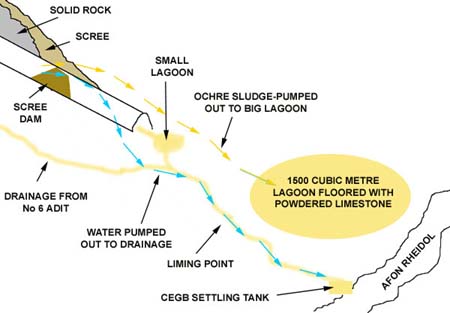
The
National
Rivers Authority (now the Environment Agency) commissioned Simon Hughes
and I to tackle the problem. This we did in 5 stages:
1.
Create large
lagoon to catch any sudden surges during works. The lagoon was floored
with hundreds of tons of powdered limestone.
2.
Remove scree
above and behind the dam in order to expose it properly.
3.
Pump out clear
water sitting on top of ca. 0.5m of ochre, liming the discharge every
15 minutes thus raising the pH from 2.5 to 5.5. This stage went on on a
24-7 basis.
4.
Pump out ochre
into the large lagoon and bury with powdered limestone.
5.
Remove dam and
repair broken lagging.
Some
aspects of
this utterly messy but ultimately successful job are illustrated below. |
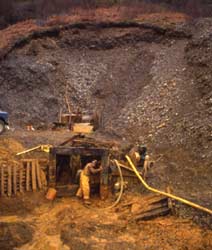
Opening up the
adit mouth and setting up pumps. A considerable amount of scree had to
be cleared off the back of the adit. The excavator dug well back to
allow for further landslides, this permitting access to a "porthole"
into the water at the back of the dam. A submersible pump was lowered
just under the surface of the water, to avoid stirring up the ochre
below. A digital pH meter was installed in the mine discharge, a large
stash of agricultural lime was placed just upstream and we were ready
to go. |

A
view up the
adit during pumping. The dam lies ahead in the darkness. While pumping
was ongoing the adit floor up to the dam was cleared of debris. |
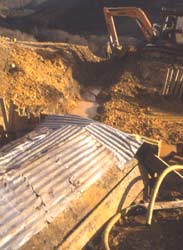
Once
the water
and ochre had been pumped well down, work commenced on tackling the
dam, a mixture of fine shale, soil and soft ochre. In this image the
dam is half-removed. The burst lagging where the shale came in is above
and to the left of the dam. |

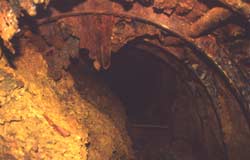
Beyond the dam
lay the inky depths of the mine which was explored for a short
distance. However, dangerous roof conditions and bad air made a full
inspection of the mine impossible. This image is taken a short way in.
Note the square timbering and copious amounts of ochre in places - it
covered the floor, walls and roof. Ochre itself is however less toxic
than the mine water with its loading of heavy metals - a classic case
of the highly visible pollution being aesthetically displeasing while
the apparently "clear" water is in fact the real rogue! |
The
lagging on
the level portal was replaced. Note that this was a temporary job
designed to tackle an environmental emergency: we made it clear at the
time that a longer-term solution must be found and implemented.
However, the adit should not let in any more scree for a few tens of
years. |
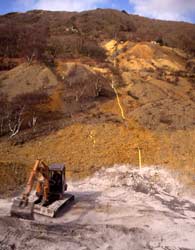
Here,
one of the NRA excavators is
spreading lorryloads of powdered limestone over the ochre pumped from
the mine into the big lagoon. The ochre in turn was pumped onto a
powdered limestone bed. This image also shows the rusty mine-tips. |
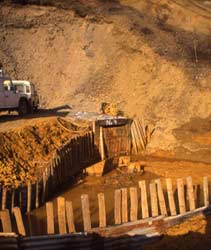
Here
the No 9 job
is nearing completion. The words "Keep Out - bad air" were added to the
mine door after this photo was taken. In front of the door are the
remains of a mine-wagon which was found buried in shale and winched out
of the way. The water was set to discharge via a pipe from this small
settling lagoon.
Although we went
home happy after completing this work, Nature was to have a nasty
surprise for us, some distance away, which 6 months after this photo
was taken was to transform the site's appearance once again. |