JOHN S. MASON - INTERPRETATION
- MAKING SCIENCE ACCESSIBLE TO ALL: AN
EXAMPLE
EXIT to
return to
John's Interpretation page.
How
can the 4,600 million
years of Earth history be appreciated by humans who measure time in
hours, days, weeks, months, years and generations? It is a massive
amount of time! To demonstrate how vast this timescale really
is,
I got the latest ages for beginnings and ends of the geological Periods
into which this long history is divided. Then I plotted them
against the 12-month calendar by which we organise our lives.
In such a plot, each month represents 4,600/12=383 million years. Each
day would represent 4,600/365=12.6 million years. Consider then:
relative to geological time, a human’s 80-year life expectancy equates
to 0.55 seconds out of the 12-month calendar, and would not even be
visible on this plot!
The graphic below is compressed for the web so sorry if it's a bit
fuzzy! The outer ring is our 12-month year while the inner ring is the
4600 million years of Earth's history. Please note that the plot is
bilingual as this version
is a reduced copy of a much larger one which I created for a Forest
Enterprise
interpretation board in North Wales.
Does this work for you? If anybody who reads this and has no prior
geological knowledge finds it informative I'd be delighted to hear from
them! It certainly made me think how chronologically insignificant Homo
Sapiens actually is...
The timescales run along with a text
timeline which
is available in full (as are hi-res versions of the graphic) for a
reproduction fee of £50 each. I work to keep the text up-to-date
as new research tweaks the ages of the oldest rocks, stratigraphic
boundaries etc. The graphic is available in TIFF format and the text is
usually supplied as a MS Word document. Below I have pasted the
beginning and the end of the text to give a flavour. 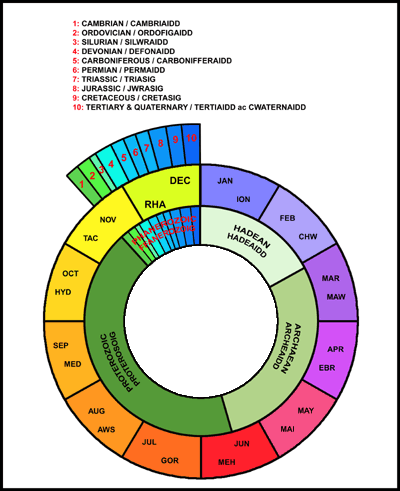 The story begins on New Year's day in
the imaginary
year: The story begins on New Year's day in
the imaginary
year:
January
1: about 4,600 million years ago. The formation of Planet Earth as it
condenses from the hot gases of the Solar Nebula...
January to late February: the Hadean eon. 4,600-3,800 million years ago
Meaning: the time of the netherworld. The new Planet Earth is largely
molten and is constantly bombarded by asteroids. The oldest rocks so
far known on Earth (around 4,280 million years old), found in Canada,
are from this time.
Late February to mid-June: Archaean eon. 3,800-2,500 million years ago.
Meaning: the ancient world. Earth now has a solid crust and oceans.
Life starts to appear in the form of bacterial colonies during March
(3,400 million years ago - oldest known fossils). But the atmosphere is
poor in oxygen and is mainly ammonia, methane, hydrogen and other
gases. The oldest rocks in the UK, found in north-west Scotland, were
formed in May......
[BREAK]
......December
26,
5.45PM-December 31, 8.29PM: The Cenozoic Era. 65-2.58 million years
ago. Meaning: (“age of recent life”). The final era begins
with
the Paleogene and Neogene systems. Under a mostly warm climate, the
mammals thrive and diversify. They include the ancestors of horses,
cattle, and, later on, apes.
December 31, 8.30pm: Start of the Pleistocene Series of the Quaternary
System. 2.58 million years ago. Several ice-ages, with warmer
interglacials in-between, affect NW Europe, in the final shaping of our
landscape.
December 31, 11.37pm: Homo Sapiens - or Modern Man - appears.
December 31, 11.58.24: Start of the Holocene Series of the Quaternary
System. 11,784 years ago. The last ice-age is over.
December 31, 11.59.47: The Romans invade Britain.
December 31, 11.59.54: The Norman conquest.
December 31, 11.59.58: The Industrial Revolution is now underway. In an
instant, computers are in widespread use. Suddenly, the clock strikes
midnight. Our trip through the past has ended. Welcome to the future....
EXIT to
return to
John's Interpretation page.
|