BACK TO WEATHER-BLOG MENU
The Welsh Weather & Dyfi Valley landscapes Image-Library - Click HERE
Grief is of course a perfectly normal part of bereavement, but in this case it has not all arrived in one great chunk, for me at least. Instead it has manifested itself in a series of stepwise shocks. According to the oft-quoted Kübler-Ross model, grief occurs in five steps: denial, anger, bargaining, depression and acceptance. I do not think, in the instance of a long terminal illness, that this is the case. The way that I have dealt with this has been with complete acceptance at each stage, but with accompanying great sadness. The last two stages thereby interweave: denial is dangerous because to deny the obvious is to ill-prepare yourself for the unfolding reality, and you don't bargain with cancer: it is not something with a conscience.
Thus there was the initial diagnosis, the possibility of recovery following surgery, the unanswered questions as to the unusual nature of that surgery, the recurrence, the appearance of metastases, the first use of the word 'palliative', the discovery that the surgery was indeed inappropriate, the spread of the metastases, the loss of ability to do those things she loved bit by bit and the final entry into the hospice last December. Wham, bam, slam, again and again and again over the years. Without doubt this has been an incredibly difficult and at times emotionally exhausting period of our lives.
But as time goes by, the stark visions of those last weeks in the hospice and watching the inevitable, as the connections that we were all so familiar with one by one disconnected, these have started to fade. In their place comes other memories - the ones that matter far more, of happier times in years past.
We never discussed matters of death and its aftermath: it simply wasn't in Mum's nature to contemplate such things. This inevitably left her survivors with the challenge of making up the rest as best we could. I'd like to think that we did a good job, and judging by the reaction of the 120-odd people who attended, it seems that we did, and we take solace in that. And so without further comment, here is the Eulogy I wrote to my mother - a celebration of her life and our memories of that - which I read at her funeral service on February 18th, because several people said they would like a copy and there were others, unable to attend, who we know would like to see what was said:
Eulogy
Shena Mason – wife to Colin of so many years, mother, facilitator and friend. Because, for us – the next generation - that's how it was. I’ll try to explain.
The story of life is one of boundaries. At first, in the fragility of childhood, we are protected from them. Then, along come the teenage years, when we begin to test them for ourselves, discovering them, pushing them, and coming to terms with our own, unique limitations along the way. Finally, with adulthood, there comes long friendship, and we can laugh with each other about them, and the scrapes that we have all encountered, on our respective journeys. And that's how it was in our lives, for which we can be grateful.
But over the past nine years, a set of new boundaries, boundaries we hoped we'd never encounter, have challenged us all. I vividly remember the night in 2005 when I heard, over the phone, that something was amiss. “Mum, I said, “between us we'll kick the stuffing out of it” (or words to that effect). And so the fight began: we all of us fought it together through its ups and downs. Indeed, as my mother said, “cancer doesn't just affect the one who has it”. This will be recognised and understood by anybody whose life has been touched by the disease.
And so on we fought, until the final months and the endless cross-country train-journeys and the evaporating hopes and the sad inevitability of it all. But even in those difficult weeks, there were moments of light. Christmas 2013 stood out as special for all of us. It was made possible to a great extent by the wonderful staff at the Marie-Curie Hospice in Solihull. Their kindness and support has been awesome and we'd like to forward all donations received today to them in honour of that.
Born in 1938, my mother had the good fortune, living as she did in Coventry, to survive everything that the Luftwaffe threw in her direction. She could recall few details from this time, and perhaps that's a good thing. Post-war holidays were spent at Cowes, on the Isle of Wight. This was where her grandparents had moved to in the face of imminent conflict, thinking it would be relatively safe. Ironically, it was their house that got bombed!
Moving on, and we fast-forward to the 1950s, when her parents relocated to the Solihull district, finally settling in Knowle, in the house that her father built for them. The passion for natural history and the love of the mountains that he possessed had by then found a new and enthusiastic devotee. This led in turn to a group of like-minded young people going off into the hills at every opportunity – including someone – Colin Mason, who was later to be my father. They were to marry in 1960.
The seeds of her professional life - which was centred around writing and journalism - were planted around the same time. The career progressed, with a few interruptions (like Fiona and myself), and led in time to her editorship of what was THE trade-journal in the jewellery sector. In later years, she found new directions, beginning with a life-changing degree-course in Literary and Cultural Studies at the University of Warwick, where she graduated with a 2:1 in the summer of 1998. Following on from that, she was to become deeply involved with a number of important heritage projects in the Birmingham district.
To give just two examples out of many: there was the wonderful and award-winning Museum of the Jewellery Quarter, which opened in 1992. Then, there was the restoration of Soho House, one-time residence of the great industrialist, Matthew Boulton. Here, well over two centuries ago, Boulton and the other members of the Lunar Society - and they were all leading figures at the time - would meet on bright, full-moon evenings for dinner and in-depth debate. The eminently sensible idea was that the moonlight would illuminate the way back home for the guests, replete with fine food, drink and philosophy. Soho House opened to the public in 1995, but I have a powerful memory of going there prior to that, when it was just an empty shell with a roof. The atmosphere in the likewise empty Lunar Room was incredible – it was if great minds had left their presence there. This we both felt, profoundly.
Research followed and her subsequent books - on the Birmingham jewellery industry and on aspects of Matthew Boulton and his family - will continue to be cited by academics for as long as there ARE academics out there. They were major contributions to the historical literature. As Dr Malcolm Dick, director of the Centre for West Midlands History, told us recently:
I have enormous respect for your mother as a person and as a scholar of Birmingham’s history.
And that goes for us too. Despite the difficulties of recent weeks, the outstanding memories will be those from further back. Walks in the woods, along the beach, sitting watching an open wood fire, enjoying good food in Essex, Wales and the Midlands alike - the simple things that are often the least expensive yet the most enjoyable - and without doubt the best antidotes to the hectic, noisy, 24-hour consumerist society that has been forced upon us in recent decades.
I'll give one detailed example among many. In the early 1970s, at every possible opportunity, we would head off to an isolated bungalow at a place called Aberedw. It was situated in the gentle, wooded and heather-topped hills of what used to be Radnorshire before the men in suits, stuck for something to do one day, fiddled with the county names. Here, we chopped firewood: we built useless but pleasing dams in the nearby river and we ranged over the hills when the weather was good, which it seemed to be all of the time.
Bilberry-picking time at Aberedw was one of the highlights of the year and not without reason. Mum's bilberry crumbles were legendary! Just in August 2010, I took Mum and Dad out in my 4x4. We wound our way up forestry tracks high above Machynlleth, to a bilberry-patch that I knew of, miles from nowhere. And she was straight on the case, despite the aches and pains that were by then part of her life, and we soon had plenty. When Mum was enthused about something there was no stopping her!
And that was the essence of her, really. That vitality, that saw her in good stead throughout her professional life, even got her safely to the summit of the Schilthorn, an extremely precipitous Swiss mountain, unroped and in atrocious wintry conditions (it's a long story – ask my Dad sometime). Enthusiasm. Energy. Vitality. With these qualities, you can make anything happen!
There are so many other things I could talk about: her love of music and her long involvement with the Margaret Wharam Choir, of gardening, of other foreign epics such as the one that involved getting all her money and paperwork stolen from her while travelling by train in the middle of India. As she was about to find out, they won't readily let you out of the country if you can't prove you got in. She got out.
So many stories, so many adventures, so many memories. Hers was a life that is worth celebrating to the full, both now and in the years to come, and for that we are all truly thankful.
A printable PDF of the eulogy is here.
Below are low-res images of the Order of Service that my sister and I put together; to download a Hi-res PDF version (1.75mb): click here.
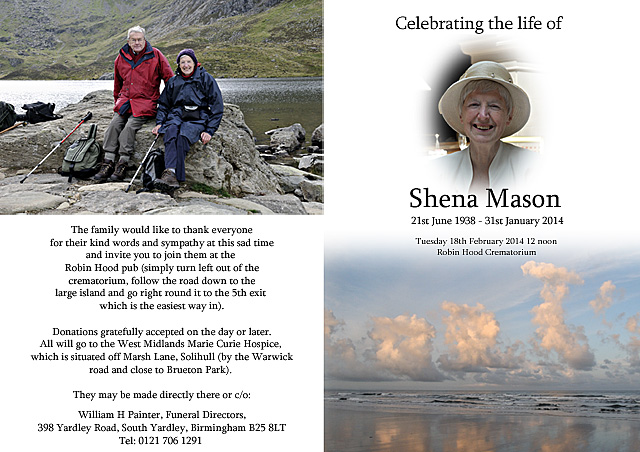
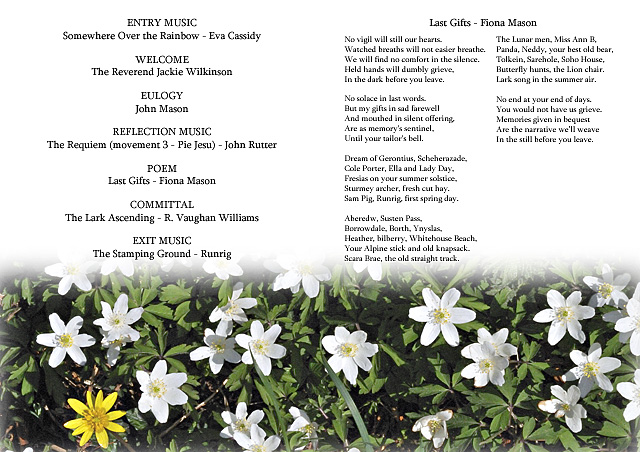
The photos are of Borth Beach, one of her favourite places in the world, of her and my father in Cwm Idwal - this being her last hill-day in September 2013, by which time everything was becoming a struggle, but the weather was kindly and she made it up to the lake: the spring flowers were something she always loved after the passing of each dark winter. The poem by my sister brings to life the things that were part of all our lives. Somehow, the standard 25 minutes that each deceased person is allotted for their service seems inadequate (to put it mildly) - there are many things that had to be left out of both our writings. But we hoped it would paint a picture of our past.
As to the choices of music: these were all things she loved. To some who knew her, the last choice - Runrig - might seem a bit odd, but in reality it wasn't at all. We went to see them live at the Symphony Hall in Birmingham some years back - a memorable night. Mum used to say that she'd sometimes be in the car in the early summer with this playing at full blast - and feel a mischievous urge to head west for adventure. Here's a link to a currently-available recording of it on Youtube.
The Welsh Weather & Dyfi Valley landscapes Image-Library - Click HERE
BACK TO WEATHER-BLOG MENU