About John Mason's
Weather Photography
and the Dyfi Valley
|
|
|
|
|
|
Short Biography
Having
slowly migrated in a north-easterly direction from Aberystwyth (where I
went to study for a geology degree in 1981), I moved to the Machynlleth
area of Mid-Wales in 1994 and after confronting a certain amount of
techno-fear, I started exploring the Internet and in time came across a
few USA Storm-Chasing websites. After a while I started to wonder: is
this possible over here?
A few exploratory trips proved it was, when in August 2000 I bagged a
beautiful funnel-cloud over the nearby hills. That was it - I was
hooked!
Since then I've been running a surprisingly popular weather-blog on my
website, and getting more and more involved in investigating extreme
weather events in the UK. We British love nothing more than to talk
about the weather and I've done that on a number of radio and TV
appearances and in illustrated talks. I'm also involved at a managerial
level in the Tornado and Storm Research Organisation (TORRO) and in the
very popular online forum at UK Weatherworld.
The media have used my work on several occasions in recent years and
BBC Wales' weatherman, Derek Brockway, has used a number of my
photographs to illustrate his recently-published book "Whatever the
Weather".
When not out with the kit, I work in geological research,
interpretation and conservation via a range of media and especially web
design. I now try to arrange my diary to avoid commitments on
potentially stormy days and I tend to work at weekends if the weather
is boring. Thus, as time goes by, and further storms are intercepted,
this site will continue to grow.
I hope you enjoy your visit to my gallery.
|

above: Bingo! My first funnel-cloud sighting, August 2000.

above: "impossible" sunrise - late November 2006. |
|
|
Using this website
I do
appreciate that people have differing amounts of time available to
browse a website like this. With this in mind, I have arranged the
images into six categories (on six pages) and I hope this makes
navigating to what you are looking for a bit easier!
The
Slide Library is subdivided into six galleries as follows:
Sorted
by weather-types:
* Thunderstorms, twisters, hazards
& damage
* Snow, Ice, Frost
& Fog
* Rain, Flood &
Drought
Sorted
geographically:
* The Cardigan Bay Coast
* The Dyfi Valley and its surroundings
* Geology and Mines
The
images on this website are low-resolution JPEGS: the master copies,
which would be used for mounted prints or digital image supply, are at
a resolution of 300 pixels per inch and in terms of print size they
vary between 16 and 36 inches longest side - not the sort of thing I'd
email to anybody without prior arrangement!
TOP
|

above:
not everybody's cup of tea of course - but if you need images of
tornado damage in Wales then you've come to the right place! |
|
|
Technical notes
I
purchased my first SLR fim camera - a Canon A-1 - in 1989 when I was
doing voluntary work for the British Geological Survey in NW Scotland -
what a place to learn about landscape photography! Today, I have three
A-1s: the original was stolen from my car in Edinburgh in 1990 and its
replacement has just been retired on compassionate grounds. They are
such robust and reliable workhorses, especially in the rough conditions
I frequently find myself working in.
Changing lenses when salt spray is flying through the air is a risky
business. Having three cameras with three different lenses circumvents
this issue neatly. The lenses begin with an ultrawide Vivitar Series
One 19-35mm, continue with a more standard Canon 28-85mm and for long
range I use a Canon 100-300mm telephoto zoom. This setup gives me a
great choice when I am composing a photograph.
I use Fuji Provia 100F film almost exclusively these days. Slides are
digitised by me on a fully calibrated system using an Epson V750 PRO
scanner at 6400 pixels/inch, creating digital images at around 300
megabytes in TIFF format. Printing is done by Redcliffe Imaging Ltd of
Bristol.
TOP
|

above: Assynt, NW Scotland - a rookie photographer's paradise! |
|
About the Dyfi Valley
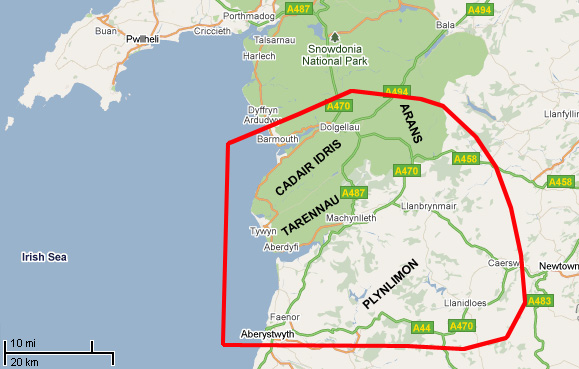
The Dyfi is one of a number of small
river-catchments that flow down the western slopes of the Welsh
mountains. Only about 30 miles from its source at Creiglyn Dyfi in the
Arans to its mouth at Aberdyfi, the river passes through a remarkably
diverse range of habitats in its course, from high mountain through
valley floodplain to saltmarsh and estuary.
The last road-crossing before the sea is Dyfi Bridge at Machynlleth,
historic market town and home of Owain Glyndwr's Welsh Parliament in
1404.
Above Machynlleth, low wooded hills, dissected by the numerous
tributories of the Dyfi, give way to higher hill-pastures and moorlands
rising towards the mountains that define the watershed of Wales. From
the mountains, eastward-flowing rivers - the Vyrnwy, Banwy and Hafren,
all unite below Welshpool as the Severn, while only a few minutes walk
from the source of the Severn on Plynlimon rises the Gwy or Wye, which
takes the short road directly SE to meet the waters of the Severn,
after their long journey through the Midlands, at Chepstow.
To cover every aspect of the Dyfi catchment and its diversity of
landscape, weather, wildlife and people would take several lifetimes.
So far I have concentrated quite naturally on my favourite things -
mountain and coastal landscapes plus the ever-changing skies, but I'm
very aware that there is much more that justifies the attention of the
lens but this is an ongoing project and the Library will continue to
expand. In fact, if there's something you are looking for but can't
find, ask and I'll see what I can do!
TOP
|
 |
|
|
|